
Manana, the newspaper lady of Sololaki
Every morning, before the city is properly awake, she arranges the entire Georgian press on a trolley on Lado Asatiani Street. This September the press gave something back: a full page in a national newspaper, all of it hers.
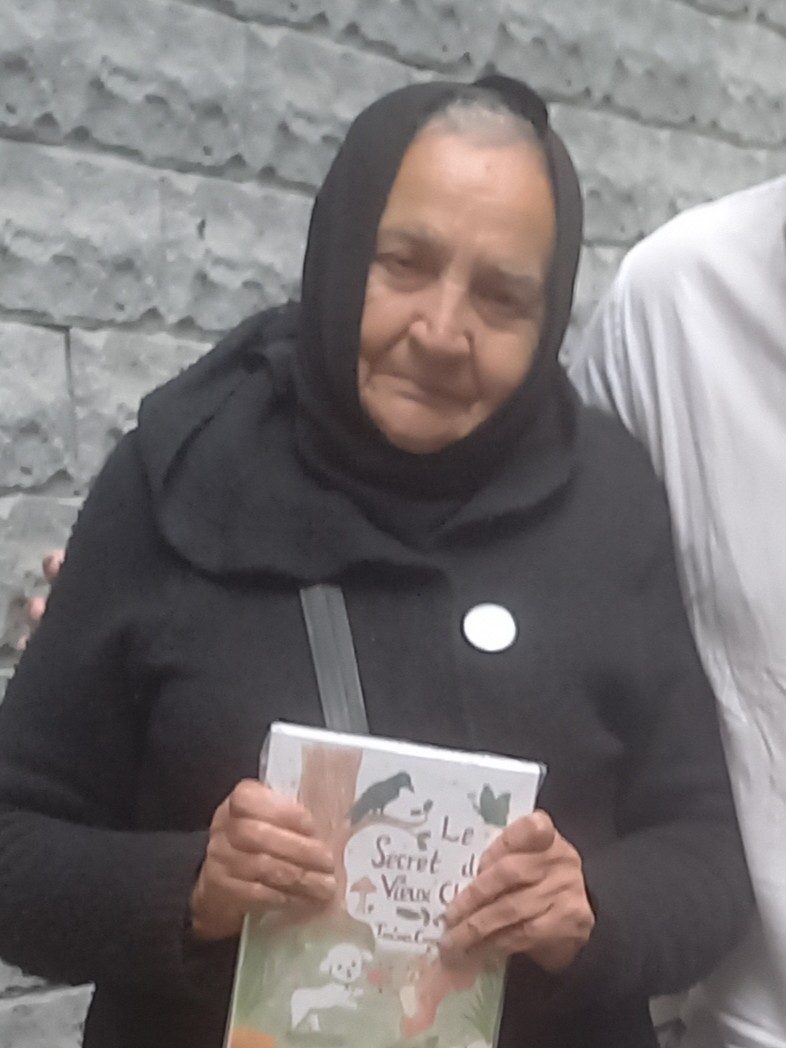
If you have ever walked down Lado Asatiani Street early enough, you have met her. The trolley arrives first — an entire newsstand folded onto a small metal frame, magazines and papers arranged in tight, deliberate rows, every masthead visible, nothing creased. Then Manana: dark clothes, straight back, scattering crumbs for the pigeons, who have learned her timetable rather better than most of her customers have.
Her name is Manana Gurgenashvili. Sololaki calls her something shorter and warmer — Mancho — and the neighbourhood has a second name for her too, one that found its way into print this autumn: the colour of Sololaki. Not a resident of the district. Its colour.
A full page, in a national newspaper
On Monday 15 September 2025, the newspaper Sakartvelos Respublika — Republic of Georgia, one of the country's national titles — gave page nine to Manana. Not a paragraph. Not a photograph with a caption underneath. The entire page, under the standing headline The Cry of the Soul.
It is worth saying plainly what that means, because she never would. Manana spends her mornings selling other people's stories, arranging other people's headlines, telling her customers which article is worth their money this week. That Monday, in one of the papers on her own trolley, the story was hers.

Page nine. Sakartvelos Respublika №126, Monday 15 September 2025.
The page shares its space, as it happens, with a list of the ten richest men on earth — Musk, Bezos, Zuckerberg, Arnault, Buffett and the rest, their billions counted out neatly beside their names. They were given a column at the bottom. Manana was given the headline.
And the headline was not written by a journalist. It was written by her daughter.
The girl who was given the job nobody wanted
Manana's working life began with an assignment that nobody her age wanted. In Soviet Georgia, the trade system — shops, supply, distribution — was not where a newly educated young woman hoped to end up. It had no glamour and no queue of volunteers. So she was singled out, and the job of making the whole sector respectable to young people was handed to her.
She did not refuse it. She went at it step by step, and the proof still exists: the diplomas, the certificates, the embroidered banners that Soviet institutions passed to whichever team had done best that year; the sector conferences and congresses in Moscow and in Leningrad; even journeys abroad, which in those years meant a great deal. She keeps all of it in what her family calls, with affection, the little museum — a box, an album, the paper record of a working life that mattered.
Then the Union came apart, and it came apart faster than anyone was ready for. People met it unprepared, she says, and she means herself as much as anybody. She got through those years. Characteristically, she also spent them helping other people get through them — holding up neighbours who were falling, putting a hand under someone's elbow, telling them it would pass.
When the old trade was gone, she moved to the press. She insists the two are not so different: there is still buying and selling, and there are still people. A different sort of relationship — but still a relationship.
Not a woman who sells newspapers
Anyone can put newspapers on a table. Manana reads them first. She goes through the new arrivals herself, and then she tells you — you specifically, by name — what is worth your money this week, what you ought to read, what you should not miss. Her customers do not so much choose a newspaper as receive advice about one.
The article that profiled her made the point exactly: she is not a woman who happens to sell the Georgian press, she is one of the people who carries it. Which is why the trolley is loaded the way it is — compact, upright, everything in view. It is a shop, assembled fresh every dawn and pushed into position before the first customer has opened his shutters.

The trolley on the pavement, and the pigeons who know the timetable. The photograph the newspaper ran at the top of the page.
15 September 2022
Manana's birthday falls on 16 September. In 2022 her daughter, Maka Sevdianishvili, did not wait for it. She wrote a day early, on the 15th, because she wanted to be first — ahead of everybody else.

A mother and her little girl — the photograph the newspaper printed beside the letter.
“Mum, my one and only, my sweet one — happy birthday. It is still only the 15th, but I want to get in ahead of everyone.”
“With God's help there will be a happy day; a wonderful day will dawn, everything will fall into place, and I will see the smile on your face again. Mum, may I keep you for a long time yet. Do not take that scoundrel's doing to heart — the Lord gives everyone their due. What matters is that we are alive, that we are together; and a mother and her child being together, and that love, never runs dry. We will manage everything. Wipe the tear from your eye, the Lord is great, everything will be all right.”
Maka Sevdianishvili · 15 September 2022The “scoundrel's doing” was not a small matter. Someone had taken advantage of Manana's willingness to trust people, and mother and daughter had lost their home. So Maka was writing to a woman who had just been left with almost nothing — and what she chose to write was: we are alive, we are together, everything will be all right.
7 October 2022
Three weeks after that letter, Maka was killed. She was Manana's only child.
Her killer was a foreign national who had come to Georgia for reasons nobody has ever satisfactorily explained. He was tried, convicted, and sentenced to twenty years. We will leave his name where it belongs, which is out of this page.
What matters here is smaller and much heavier: the last birthday letter Manana received from her daughter is now the only birthday letter she will ever receive from her — and it happens to be one of the kindest things anyone has ever written down. Three weeks before she died, a young woman took the trouble to sit and tell her mother, who had just lost her home, that everything would be all right.
Manana kept working. The trolley still goes out before dawn.
What the street did
Then people appeared — which is, in the end, the other half of this story. Businessmen and pensioners, the city hall and the neighbours, some of them close friends and some of them strangers who simply took a corner of the weight because they could not do nothing. The newspaper devoted most of a column to listing them by name: Tbilisi's mayor; the head of the city's health and social services department; a businessman here, a poet there; and behind them a long line of Sololaki people whose only qualification was that they live nearby.
The rest of the page is birthday messages, gathered from Facebook and printed exactly as they were written.
Why we are telling you this
We say on this site that our ladies are not beneficiaries — that they are the stars of this neighbourhood, and that this journal is simply their press. Every so often the point makes itself without our help. This September the national press agreed with us in the most literal way available: a full page, her photograph at the top of it, and her daughter's words set in the headline.
She will not tell you any of this. If you buy a paper from her on Lado Asatiani Street she will tell you which article is worth reading, and she will be right. So we are telling you instead.
Happy birthday, Mancho — from your street.
← Back to the journal